
Capacity building and knowledge exchange
Weaving a Future: A Curriculum for Nasa Political and Cultural Leadership
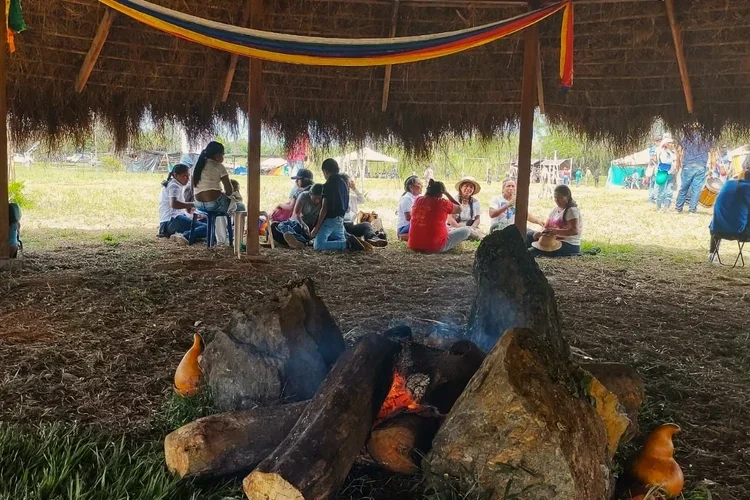
The UNESCO Chair is funding a project in which representatives of the Association of Indigenous Councils of the Northern Cauca Department (ACIN) and the Indigenous authorities of the Resguardo de Huellas, Caloto will develop a comprehensive curriculum that not only trains young people in the key skills required for Indigenous leadership but also strengthens the cultural and organisational fabric by promoting the transfer of knowledge between generations.
Visiting Researchers
As part of the UNESCO Chair's knowledge exchange programme we are able to sponsor one visiting researcher scholarship per year. The exchange can be approximately 6 weeks in length and requires a mutually agreed programme of work between the researcher and the host university. The fellowship will cover all relevant costs, including travel, accommodation and a stipend.
Researchers can arrange to be hosted by any university within the UNESCO Chair network. The aim of the exchanges is to share knowledge and build capacities on universities as sites of activism and protection. Applications that seek to build links between universities in the Global South are particularly welcome.
Accounts of the experiences of previous visiting researchers can be found below.
Wouter Vandenhole, Research Scholar 2025-26
“I had the immense pleasure and privilege of spending two months at the Centre for Applied Human Rights (CAHR) at the end of 2025 and in early 2026, during my research leave. I had a very enjoyable and productive stay at CAHR. I got to know CAHR as a tight-knit research community with a strong commitment to human rights. CAHR shows that academic excellence and societal engagement can go hand in hand and mutually reinforce each other.
During my research leave from the University of Antwerp, I have worked on the topic of universities as emerging human rights duty-bearers. Universities may be directly or indirectly involved in human rights violations. Typically, they are not held to account under human rights law. I have researched what it would take to construct universities as human rights duty-bearers, and what the implications would be. Following work on conceptual questions such as how universities can be conceived of as (emerging) human rights duty-bearers; how human rights obligations can be assigned to universities; and what the nature of their obligations is, could or should be, I have sought to illustrate and refine the implications of approaching universities as human rights duty-bearers in the realms of academic freedom; procurement and investment; and partnerships and cooperation.
During my research stay at CAHR, I finalised a paper on the implications of institutional human rights responsibility of universities for academic freedom, and another one on universities' human rights obligations in procurement and investment. Both have been published in the Working Paper Series of the UNESCO Chair in Protection of Human Rights Defenders and Expansion of Political Space (Working Papers 7 and 9).
I am most grateful to the staff and human rights defenders at CAHR for their hospitality, the coffee breaks, the sweets, the informal chats, the sharing of experience and knowledge! All of them have been very generous with their time and kind to me in their own way. It made me feel genuinely at home and has allowed me to make important progress on my research agenda. Thank you, keep up the good work and let’s stay in touch!”
Wouter Vandenhole, Professor in Human and Children’s Rights, Law and Development Research Group, University of Antwerp (Belgium)

Rosario Figari-Layús, Research Scholar 2024
“During the months of February and March 2024 I had the great opportunity to carry out a research stay at the University of York as a visiting scholar. My research visit was a great experience in which I had the possibility to meet brilliant and collegial researchers who shared with me their knowledge and research projects in the field of human rights, peace-building and conflict transformation. I was also invited to present my research projects while participating in several workshops and discussions with colleagues from CAHR, from other departments, and also with human rights defenders, hosted by the University of York.
The research scholarship enabled deep academic exchanges that contributed to identifying common research interests and to building up international networks with CAHR colleagues, as well as starting to develop research proposals for joint projects in the field of human rights with innovative and interdisciplinary approaches, strengthening at the same time the future academic international cooperation.
The research scholarship allowed me also to know more deeply the amazing work of the UNESCO Chair Human Rights Defenders Hub and the importance of strengthening the role of universities in the defense and protection of human rights. Finally, I would like to express my gratitude to the whole staff of CAHR, who were very open, friendly and generous. They were a great support to make me feel at home and more than welcome not only in the academic life at the university but also sharing different activities in the beautiful city of York. To all of them thank you very much!”
Rosario Figari Layús, PhD., Junior-Professor for Reconciliation Studies, Friedrich-Wilhelms-Universität Bonn (Germany)